SS-4 Form Guide
Form SS-4 is the application for an Employer Identification Number, the nine-digit tax ID that businesses, trusts, estates and other organizations use with the IRS. You need one to hire employees, to form a partnership or corporation, and often to open a business bank account.
How to Fill Out a SS-4 Form?
- 1Click Fill Form. Form SS-4 opens in our editor, with its fillable fields shown in blue.
- 2Click a field to type, tick the boxes that apply, or add text, check marks and dates anywhere on the page.
- 3Click Download, choose PDF, Word or an image, name the file and save it.
What Is the SS-4 Form Used For?
The information on Form SS-4 sets up the entity's business tax account with the IRS, and the IRS may use it to work out which federal tax returns the entity has to file. You can fax or mail the completed form. International applicants who apply by phone should fill it out before calling, because the IRS representative uses its answers to set up the account. Page 2 of the form has a table showing which lines to complete for your situation.
- Starting a new business, or hiring employees, including household employees.
- Opening a bank account that needs an EIN for banking purposes only.
- Changing the type of organization, such as incorporating a sole proprietorship, or buying an existing business.
- Creating a trust or pension plan, or administering an estate that reports income on Form 1041.
- Foreign persons and withholding agents who need an EIN to comply with IRS withholding rules.
Who fills it in
Businesses, organizations, trusts and estates that need an EIN.
Where it goes
Fax or mail it to the IRS, as the instructions explain. Most US applicants can also apply online on irs.gov and get the number right away.
When Don't You Need a New EIN?
Don't apply for a new EIN if an existing entity only changed its business name, elected on Form 8832 to change how it's taxed, or ended its partnership status because at least 50% of the partnership's capital and profits interests were sold or exchanged within 12 months. An existing corporation electing or revoking S corporation status also keeps its current EIN. And if you already have an EIN, you don't apply again just because you're adding a place of business or hiring employees.
A sole proprietor generally needs only one EIN, no matter how many businesses or trade names they run. Certain grantor-type trusts don't need one if the trustee gives all payers the grantor's name and TIN and the trust's address. Whatever your situation, use only one application method per entity so you don't end up with more than one EIN.
How Do You Update Your EIN Information Later?
Use Form 8822-B to tell the IRS about changes to the entity's responsible party, mailing address, or location. A change in the responsible party must be reported within 60 days.
Some changes need a new EIN rather than an update. For example, if a sole proprietorship incorporates or enters into a partnership, it must apply for a new EIN. If you buy an existing business, don't use the former owner's EIN unless you became the owner of a corporation by acquiring its stock.
Instructions for Filling Out the SS-4 Form
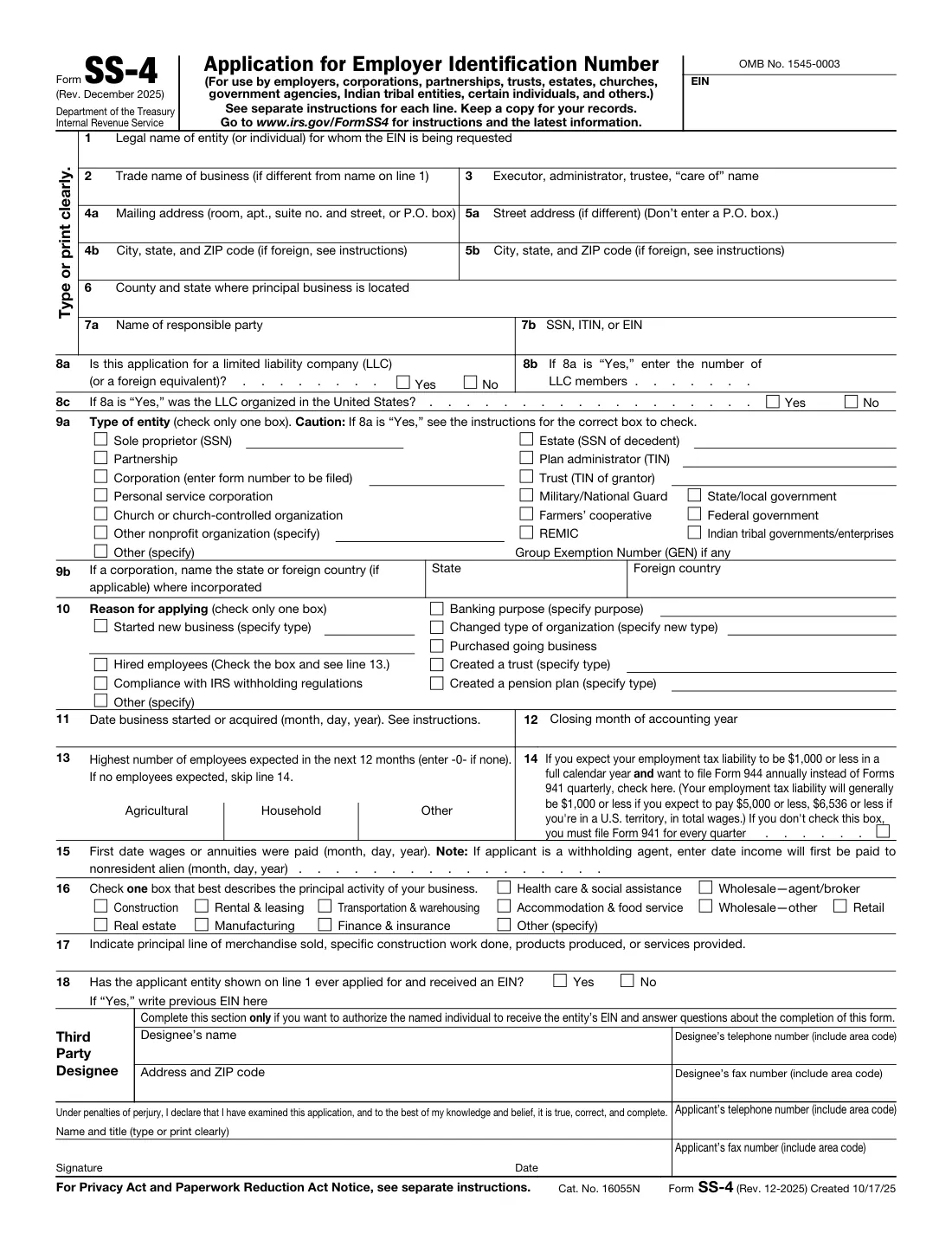
Type or print clearly, and generally enter "N/A" on any line that doesn't apply. The table on page 2 shows which lines your situation requires.
 Get form
Form SS-4, 2 pages. View all pages
Lines 1 to 7b: About the Applicant
- Line 1
- Legal name of entity (or individual): Enter the legal name exactly as it appears on the social security card, charter, or other legal document; an entry is required. Sole proprietors enter their own first name, middle initial, and last name, not the business name. Corporations include any suffix such as Inc., Corp., or PC, and an estate with no legal name uses the decedent's name followed by "Estate."
- Line 2
- Trade name of business: Enter the "doing business as" name only if it differs from line 1. Use the same name, legal or trade, on all your tax returns to avoid processing delays.
- Line 3
- Executor, administrator, trustee, "care of" name: Trusts enter the trustee's name, and estates enter the executor, administrator, personal representative, or other fiduciary. An entity with a designated person to receive tax information can enter that person here.
- Lines 4a and 4b
- Mailing address: Enter the address for the entity's correspondence; it will generally be used on all tax returns. For a foreign address, include the city, province or state, postal code, and the full country name. If you completed line 3, use that person's address.
- Lines 5a and 5b
- Street address: Enter the entity's physical address only if it's different from the mailing address. Don't use a P.O. box.
- Line 6
- County and state where principal business is located: Enter the county and state of the entity's primary physical location.
- Lines 7a and 7b
- Responsible party: Enter the full name and SSN, ITIN, or EIN of the person who ultimately owns or controls the entity. Unless the applicant is a government entity, this must be an individual and line 7b must show an SSN or ITIN. If that person doesn't have and can't get an SSN or ITIN, enter "foreign" or N/A.
Lines 8a to 9b: Type of Entity
- Lines 8a to 8c
- LLC questions: Answer Yes on line 8a if the applicant is an LLC (or a foreign equivalent), then enter the number of members on line 8b and say on line 8c whether it was organized in the United States. An LLC owned only by an individual and their spouse in a community property state, who choose to treat it as a disregarded entity, enters 1 on line 8b.
- Line 9a
- Type of entity: Check only one box and add any number it asks for, such as your SSN for a sole proprietor or the decedent's SSN for an estate. A single-member LLC that will be disregarded checks Other and writes "disregarded entity," while a multi-member LLC accepting partnership treatment checks Partnership. An LLC electing to be taxed as a corporation or S corporation checks Corporation and enters Form 1120 or 1120-S.
- Line 9b
- State or foreign country of incorporation: If the applicant is a corporation, enter the state or foreign country where it was incorporated.
Lines 10 to 18: About the Business
- Line 10
- Reason for applying: Check exactly one box; a selection is required and "N/A" isn't allowed. Fill in any detail the box asks for, such as the type of business started or the type of change, for example "From sole proprietorship to partnership."
- Line 11
- Date business started or acquired: Enter the date you started the business, or the date you acquired a business that was already operating. Trusts enter the date the trust was funded, and estates enter the date of death or the date the estate was legally funded.
- Line 12
- Closing month of accounting year: Enter the last month of your tax year. Individuals generally use a calendar year, which ends in December. Partnerships, personal service corporations, trusts, and REMICs have special rules in the instructions.
- Line 13
- Highest number of employees expected in the next 12 months: Enter the number of agricultural, household, and other employees you expect in the next 12 months, writing -0- in any box where you expect none. If you expect no employees at all, skip line 14.
- Line 14
- Form 944 election: Check this box if you expect your employment tax liability to be $1,000 or less for a full calendar year and want to file Form 944 once a year instead of Form 941 each quarter. The form notes this generally means paying $5,000 or less in total wages, or $6,536 or less in a U.S. territory. Once you check it, you must keep filing Form 944 until the IRS tells you to file Form 941.
- Line 15
- First date wages or annuities were paid: Enter the date the business began paying wages or annuities, or "N/A" if it doesn't plan to have employees. Withholding agents enter the date income will first be paid to a nonresident alien.
- Line 16
- Principal activity: Check the one box that best describes the business's main activity, such as construction, retail, or health care and social assistance. If none fits, check Other and describe the activity; you must check a box.
- Line 17
- Principal line of business: Describe the main merchandise sold, construction work done, products produced, or services provided in more detail; an entry is required. For example, after checking Construction on line 16, you might enter "General contractor for residential buildings."
- Line 18
- Previous EIN: Check Yes or No to show whether the entity on line 1 has ever applied for and received an EIN. If Yes, write the previous EIN.
Third Party Designee and Signature
- Third Party Designee
- Designee's name, address, phone, and fax: Complete this only if you want to authorize a named person to receive the entity's EIN and answer questions about the form, and sign the form so the authorization is valid. The designee's authority ends once the EIN is assigned and released to them. If the designee's address or phone number matches yours, the application must be mailed or faxed.
- Signature
- Name, title, signature, and date: Print the signer's name and title, sign, date the form, and add the applicant's phone and fax numbers. An individual signs for themselves, a corporation's president, vice president, or other principal officer signs for it, a responsible and duly authorized member or officer signs for a partnership or other unincorporated organization, and the fiduciary signs for a trust or estate.
Tips for Filling Out the SS-4 Form
- An EIN is free from the IRS. You never need to pay anyone to get one.
- The responsible party on line 7a must be a person who controls the business.
- Applying online is fastest. Fax is usually faster than mail.
Fill Out Form SS-4 Online
The official form opens with its fields ready to type in. Free, no sign-up, no watermark.
Official PDF on irs.govGot Questions?
Do I need an EIN as a sole proprietor?
Only in some cases, for example if you hire employees or file certain tax returns. Otherwise you can use your Social Security number. The form's instructions explain who needs one.
How long does it take to get an EIN?
If you apply online, you can get the EIN right away and use it immediately. By fax, you'll generally get it within 4 business days, and by mail in about 4 weeks, so the instructions suggest mailing the form at least 4 to 5 weeks before you need the number.
Can I get more than one EIN on the same day?
No. The IRS issues only one EIN per responsible party per day, whether you apply online, by phone, by fax, or by mail. For trusts the limit applies to the grantor, owner, or trustor, and for estates to the decedent or the debtor.
What if a tax return is due before my EIN arrives?
Write "Applied For" and the date you applied in the space for the number, and don't use your SSN instead. If a tax deposit is due, send the payment to the IRS service center for your filing area, payable to the "United States Treasury" and showing your name as on Form SS-4, address, type of tax, period covered, and the date you applied.
Does a single-member LLC need its own EIN?
It does if it needs one to file Form 8832, to file employment or excise tax returns, or for state reporting purposes, or if it's a foreign-owned U.S. disregarded entity that must file Form 5472. A disregarded entity must use its own name and EIN to report and pay employment taxes.
Can I fill out Form SS-4 online for free?
Yes. Click Fill Form and Form SS-4 opens in our editor with its 89 fields ready to type in. When you are done, download it as a PDF, Word file or image. There is no account to create and no watermark.
Is this the official Form SS-4?
Yes. It is the official PDF from the IRS website (Rev. December 2025), with its own fillable fields. Forms are updated from time to time, so check the version on the IRS website before you file.
PDFezy Reviews
No reviews yet. Used this form? Tell others how it went.