W-9 Form Guide
Form W-9 is how a US person gives their name, address and taxpayer identification number to someone who has to report payments to the IRS, such as a client paying you as a freelancer, a bank or a broker. The payer uses it to fill in forms like the 1099-NEC at the end of the year. You also certify that the number is correct and whether you are subject to backup withholding.
How to Fill Out a W-9 Form?
- 1Click Fill Form. Form W-9 opens in our editor, with its fillable fields shown in blue.
- 2Click a field to type, tick the boxes that apply, or add text, check marks and dates anywhere on the page.
- 3Click Download, choose PDF, Word or an image, name the file and save it.
What Is the W-9 Form Used For?
Payers and financial institutions ask for a W-9 when they have to report an amount to the IRS on an information return and need your correct taxpayer identification number (TIN) to do it. Your TIN can be a Social Security number (SSN), an individual taxpayer identification number (ITIN), an adoption taxpayer identification number (ATIN) or an employer identification number (EIN). The signed form also confirms that you are a US person, so the payer doesn't apply the withholding rules meant for foreign persons.
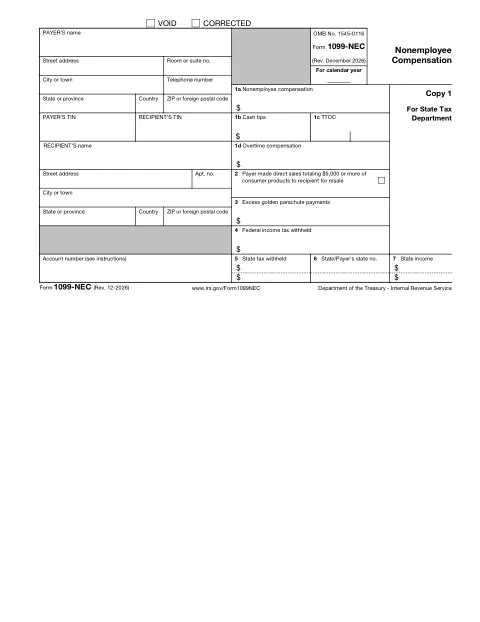
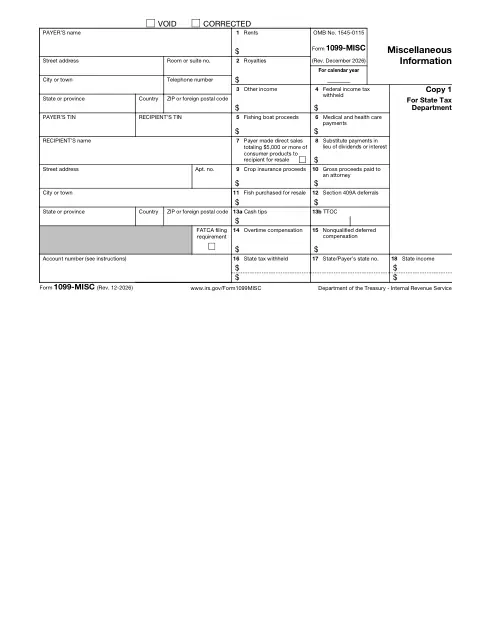
- Freelance or contract pay reported on Form 1099-NEC, and prizes, awards or other income reported on Form 1099-MISC
- Bank and brokerage accounts that report interest (1099-INT), dividends (1099-DIV) or sales of stock and mutual funds (1099-B)
- Payment card and third-party network payments (1099-K) and real estate sale proceeds (1099-S)
- Mortgage interest (1098), student loan interest (1098-E), tuition (1098-T) and canceled debt (1099-C)
- Claiming an exemption from backup withholding or FATCA reporting, if your entity qualifies for one
Who fills it in
US citizens, resident aliens, US companies, partnerships and LLCs that a payer asks for one.
Where it goes
Give it to the person or business that asked for it. Don't send it to the IRS.
When Might Filling Out a W-9 Not Be Necessary?
The W-9 is only for US persons: US citizens and resident aliens, plus partnerships, corporations, estates and trusts that are domestic. If you are a nonresident alien or a foreign entity, give the requester the right Form W-8 or Form 8233 instead. The same goes for a US disregarded entity with a foreign owner: the owner gives a Form W-8, even if it has a US TIN.
You also may not need the official W-9 itself. If you are a US person and the requester gives you its own form to collect your TIN, you must use that form as long as it is substantially similar to the W-9.
When Should You Submit an Updated W-9?
Give the requester a new W-9 if the name or TIN on the account changes. For example, a new form is needed when the grantor of a grantor trust dies. If you give a new address on line 5, the instructions say to enter "NEW" at the top, though the payer may keep using the old address until it updates its records.
If you told a payer you were an exempt payee and that is no longer true, you must give them updated information if you expect reportable payments from them in the future. This can happen when a C corporation elects to be an S corporation, or when an organization is no longer tax exempt.
Instructions for Filling Out the W-9 Form
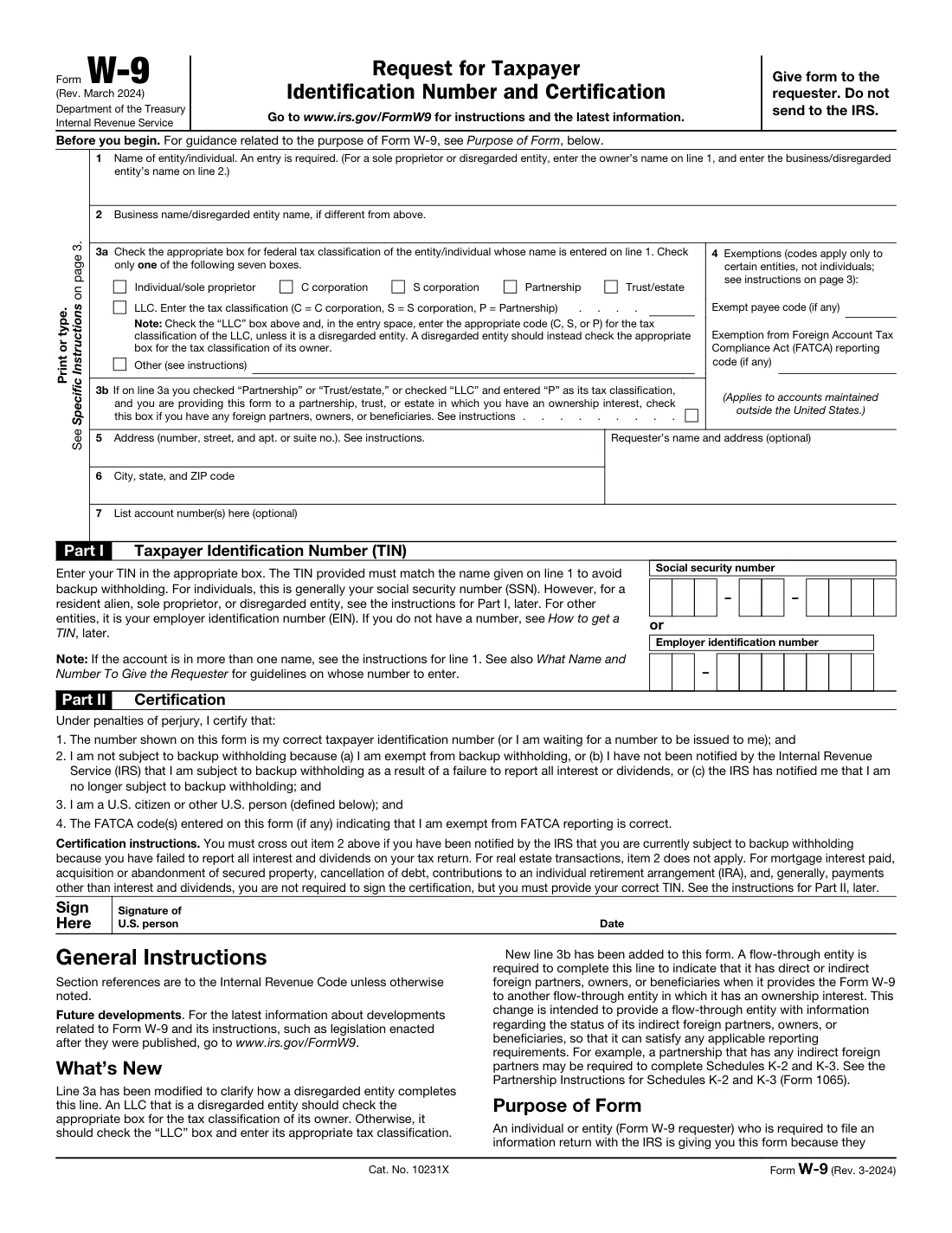
Type or print your answers. Lines 1 to 7 identify you, Part I holds your TIN, and Part II is where you certify the information and sign.
 Get form
Form W-9, 6 pages. View all pages
Taxpayer Details (Lines 1 to 7)
- Line 1
- Name of entity/individual: This line is required, so don't leave it blank. A sole proprietor or the owner of a disregarded entity enters the owner's own name here, not the business name. For a joint account, list first, and circle, the name of the person whose TIN you give in Part I.
- Line 2
- Business name/disregarded entity name: Enter any business, trade or "doing business as" (DBA) name, or the name of your disregarded entity. Leave it blank if it is the same as line 1.
- Line 3a
- Federal tax classification: Check only one of the seven boxes for the person or entity on line 1. An LLC checks the LLC box and enters C, S or P for how it is taxed. An LLC that is a disregarded entity instead checks the box for its owner's classification.
- Line 3b
- Foreign partners, owners or beneficiaries: This line is new on the March 2024 revision. Check it only if you are a partnership (including an LLC taxed as one), trust or estate with any foreign partners, owners or beneficiaries, and you are giving the W-9 to a partnership, trust or estate in which you have an ownership interest.
- Line 4
- Exemptions: Enter an exempt payee code (1 to 13) or a FATCA exemption code (A to M) only if one applies. These codes are for certain entities, such as corporations and tax-exempt organizations; individuals and sole proprietors generally aren't exempt from backup withholding. FATCA codes only matter for accounts kept outside the United States, so you may leave that box blank for a US account.
- Line 5
- Address: Enter your number, street and any apartment or suite number. This is where the requester will mail your information returns.
- Line 6
- City, state, and ZIP code: Enter the city, state and ZIP code that go with the address on line 5.
- Line 7
- Account number(s): Optional. You can list the account number or numbers this W-9 is for.
- Requester's name and address
- Requester's details: Optional. This box is for the name and address of the person or business asking for the form.
Part I: Taxpayer Identification Number (TIN)
The number you enter must match the name on line 1, or you could face backup withholding.
- Part I
- Social security number: Individuals generally enter their SSN here. A resident alien who doesn't have, and can't get, an SSN enters their ITIN in this box instead. A sole proprietor who has an EIN may enter either number, though the IRS encourages using the SSN.
- Part I
- Employer identification number: Corporations, partnerships and other entities enter their EIN here.
- Part I
- If you don't have a TIN yet: Apply for one right away (Form SS-5 for an SSN, Form W-7 for an ITIN, or Form SS-4 for an EIN), write "Applied For" in the TIN space, then sign, date and return the form. For interest, dividends and certain payments on readily tradable instruments, you generally have 60 days to give the requester your TIN before backup withholding starts. The 60-day rule doesn't apply to other payments.
Part II: Certification
- Part II
- Certification items 1 to 4: By signing, you confirm that your TIN is correct, that you aren't subject to backup withholding, that you are a US person, and that any FATCA code you entered is correct. If the IRS has told you that you are currently subject to backup withholding because you didn't report all interest and dividends on your tax return, cross out item 2 before signing. Item 2 doesn't apply to real estate transactions.
- Sign Here
- Signature of US person and date: For a joint account, only the person whose TIN is in Part I signs, and for a disregarded entity, the person named on line 1 signs. For some payments, such as mortgage interest you paid, canceled debt, IRA contributions and, generally, payments other than interest and dividends, you don't have to sign but must still give your correct TIN. The requester may still ask you to sign.
Tips for Filling Out the W-9 Form
- Use the name shown on your tax return on line 1. Fill in line 2 only if you have a different business name.
- Tick one federal tax classification on line 3a. Pages 2 to 6 of the form explain each box.
- Enter either your Social Security number or your EIN in Part I, not both.
- Sign and date Part II before you send it.
Fill Out Form W-9 Online
The official form opens with its fields ready to type in. Free, no sign-up, no watermark.
Official PDF on irs.govGot Questions?
Do I send Form W-9 to the IRS?
No. You give it to the person or business that asked for it, and they keep it for their records.
Is it safe to send a W-9 by email?
It shows your Social Security number or EIN, so only send it to someone you know asked for it, ideally through a secure upload or encrypted email.
What is backup withholding?
It is tax that a payer must withhold at 24% and send to the IRS from certain payments, such as interest, dividends, rents, royalties and nonemployee pay. It can apply if you don't give your TIN, the IRS says your TIN is incorrect, or you don't make the required certifications. You generally avoid it by giving your correct TIN, certifying, and reporting all your taxable interest and dividends on your tax return.
What name do I use if I changed my last name?
If you haven't told the Social Security Administration about the change, enter your first name, the last name shown on your Social Security card, and your new last name on line 1.
How does a single-member LLC fill out a W-9?
If the LLC is disregarded for tax purposes, put the owner's name on line 1 and the LLC's name on line 2, check the box for the owner's tax classification on line 3a, and enter the owner's SSN or EIN in Part I. If the LLC is taxed as a corporation or partnership, it checks the LLC box with C, S or P and enters its own EIN.
I'm a resident alien claiming a tax treaty exemption. Do I need anything extra?
Yes, if you rely on an exception in the treaty's saving clause. Attach a statement to your W-9 that gives the treaty country, the treaty article covering the income, the article that contains the saving clause and its exceptions, the type and amount of income, and the facts that justify the exemption.
Can I fill out Form W-9 online for free?
Yes. Click Fill Form and Form W-9 opens in our editor with its 23 fields ready to type in. When you are done, download it as a PDF, Word file or image. There is no account to create and no watermark.
Is this the official Form W-9?
Yes. It is the official PDF from the IRS website (Rev. March 2024), with its own fillable fields. Forms are updated from time to time, so check the version on the IRS website before you file.
PDFezy Reviews
No reviews yet. Used this form? Tell others how it went.